
What We Choose to Crown

On photographs, remnants, and the architecture of memory

Three coffees into Sunday morning, I fell asleep.
Apparently caffeine has its limitations.
When I woke, I found myself looking across the bed toward Robert’s nightstand. My eyes settled on the narrow edge of a gold picture frame.
I wasn’t looking at the photograph.
I was looking at what surrounded it.
From where I lay, the frame looked remarkably like a crown.
Beside it stood my favourite art object in our home, a sculptural iron vessel by Jan Barboglio, with small iron birds suspended around its dark form. Robert had arranged the pieces together. His glasses, watch and telephone sat nearby.
Gold. Iron. Memory. The ordinary evidence of Sunday morning.
Nothing had been staged.
And suddenly I wondered:
What do we choose to crown?
I got up and began walking through our home.
Once I started looking, the crowns were everywhere.
Silver. Bronze. Gold. Some elaborate, others restrained. Some surrounding photographs, others documents, paintings or fragments of paper that had somehow survived decades of editing.
I began photographing them.
A photograph of a photograph.
Then another.
Memory inside a frame, inside a room, inside another photograph.
A small fractal of our lives.

One of the first I stopped at was a black-and-white photograph I took of Robert in Paris. It was, I believe, our first trip there together.
He is leaning against a wall overlooking the Seine, his attention somewhere beyond me. I have always loved his profile.
The photograph is surrounded by an ornate silver frame and a generous ivory mat.
I did not choose it.
For many years, we entrusted much of our framing to a professional framer, often giving them carte blanche. They would study the subject, its proportions, colour and character, then choose from the remnants of moulding available.
That word stayed with me.
Remnants.
I know something about remnants.
In fashion, they accumulate quietly after the important cutting has supposedly been done. Pieces too small for their original purpose, perhaps, but far too beautiful to discard.
A framer sees possibility in them.
So does memory.

Then there is Rupert.
Some of you will remember him.
At our 11th Avenue location, Robert’s furniture store flowed directly into my bridal salon. There was no hard boundary between the two spaces, and clients wandered naturally from one world into the other.
Rupert worked both.
He came with us every day, those unmistakable “moppy” ears appearing whenever someone arrived.
“RRUUUUpert!” clients would call when they saw him.
He belonged equally to the furniture store and the bridal salon, apparently unconcerned with departmental distinctions.
People still ask us about Rupert. He has been gone for some time now, but those moppy ears made themselves rather difficult to forget.
Today, three photographs of him sit together in a magnificent bronze foliate frame. The centre photograph shows his favourite perch at the Montage, looking toward the ocean—a view he may have appreciated even more than we did.
Rupert had no professional accomplishments to commemorate. No trunk shows. No documents requiring preservation.
He was simply loved.
Apparently that was quite sufficient to earn him a crown.

Another frame contains a painting I made of Paris before I attended the Paris Fashion Institute.
It was Paris before Paris.
Turquoise, yellow and red. Café awnings and shutters. A city constructed from imagination rather than experience.
Years later, elsewhere in our home, there is Robert standing beside the actual Seine.
One Paris imagined.
Another lived.
Both remain.
Then there is Bergdorf Goodman.
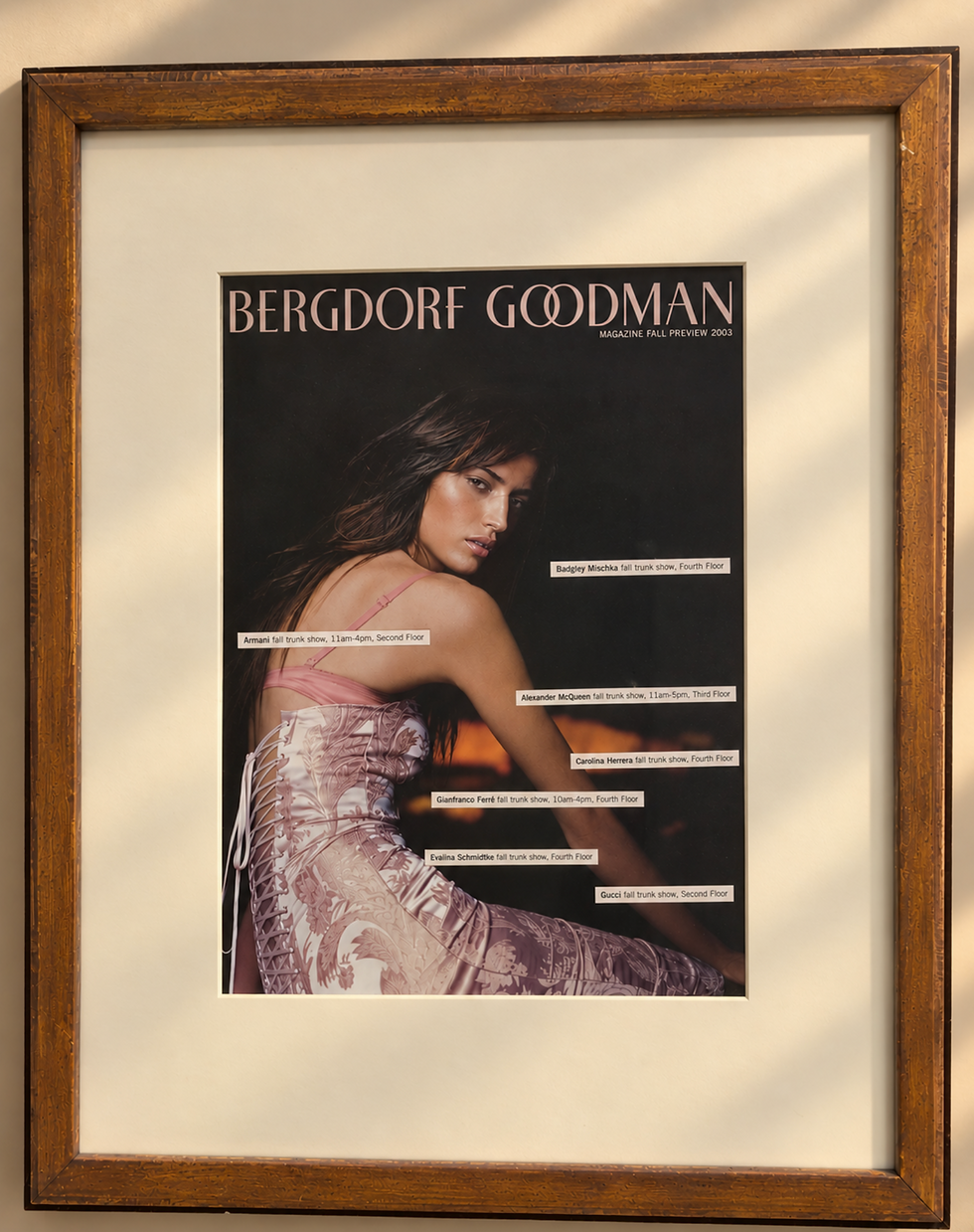
Behind glass is a page from its Fall 2003 magazine announcing the season’s trunk shows.
Armani. Alexander McQueen. Carolina Herrera.
And there, on the fourth floor:
Evalina Schmidtke.
A bridal trunk show.
Even now, I find it slightly difficult to comprehend.
Robert had instigated that first meeting with a potential buyer. He possessed an extraordinary ability to enter situations convinced something was possible before there was much evidence to support the theory.
His introduction opened the door.
My work then had to walk through it.
The magazine page remains because it is evidence.
This happened.
Sometimes that is reason enough to place a crown around something.

In New York, Robert and I once wandered into a rare bookshop and found a small old document carrying several handwritten signatures.
We chose it because we liked it visually.
Only afterward did the woman in the shop tell us that one of the signatures was associated with an illustrator connected to Charles Dickens. I remember being delighted that I had selected it with my eye before knowing anything about its possible history.
We brought it home.
Today that tiny scrap of paper occupies an extraordinarily handsome gilded frame.
Its physical dimensions are almost comically insignificant compared with the space surrounding it.
Perhaps crowns understand that size and significance have very little to do with one another.
Then there is something most people would probably have thrown away.
A sales document from Guillaud S.A. in France for the fabrics used in the wedding gown I designed for myself.
The swatches are still attached.

Above it hangs a photograph of me wearing the finished gown on our wedding day.
I embroidered the corset myself, using the tonalities and fabrics recorded on that document: hand-formed roses in pink, with vines of leaves worked through the taupe tones.
The photograph records the finished moment.
The document records the making.
Fabric ordered. Colours chosen. Hands working.
A dress.
A wedding.
A happy day.
We do not always crown the beautiful object.
Sometimes we crown the evidence.
Standing among all these frames, I realized I had not chosen most of their crowns.
Someone else had.
A professional framer who did not stand beside us in New York. Who did not know Rupert’s favourite perch. Who was not there when Bergdorf Goodman seemed unimaginable. Who did not embroider those roses.
They knew only what had been placed on the worktable.
And yet they looked carefully.
A cool silver crown for one memory.
Bronze foliage for another.
Old gold around an accomplishment.
Elaborate gilding around a tiny scrap of handwriting.
Some crowns speak loudly.
Others understand that what sits inside them has already said enough.
Over the years, I stopped seeing those choices.
The frame became inseparable from the memory.
Until Sunday morning.
I returned to Robert’s nightstand.
His glasses.
His watch.
His telephone.
The iron vessel with its suspended birds.
And that narrow edge of gold.
These objects from other times do not live in a museum. They live among the ordinary evidence of today. We put things in front of them. Walk past them. Dust around them.
Eventually, we stop seeing them.
Until the morning light strikes something at precisely the right angle.
Perhaps that is what a home becomes after enough years together.
Not a collection of possessions.
An architecture of significance.
Things carried from one house to another. Things we refused to throw away. Things whose monetary value became irrelevant long ago.
Things that prove where we went.
Whom we loved.
What we made.
What we imagined.
And occasionally, that something improbable really did happen.
Later, looking through the photographs I had taken, another thought occurred to me.
I had spent the morning photographing photographs.
Selecting from things already selected.
Framing things already framed.
And now I have placed a few of them here.
Not all of them.
Perhaps that is what the Robert Sweep Journal has quietly become as well.
It is not our life.
It is a frame placed around certain moments of it.
You see the photograph.
You see the crown.
You may even see Robert’s glasses on his nightstand.
But beyond the edge of the picture, life continues.
Some things belong inside the frame.
Some things remain ours.
We cannot keep everything.
So we choose what to crown.


Comments